
Banking infrastructure is being rebuilt from the inside out. Across the industry, banks are re-platforming credit, custody, and client servicing onto fintech that sits inside their existing stack rather than replacing it.
Lombard lending is one of the clearest examples of what’s at stake when that infrastructure is missing.
Lending against a client’s portfolio, without requiring them to sell down or move custody, has historically been a product reserved for the largest private banking relationships. Specialised infrastructure has been needed to originate, monitor and risk-manage it at scale – infrastructure that only big banks could afford to invest in and develop.
That is changing. Purpose-built fintech is now letting banks embed Lombard lending directly into their existing service model – white-labelled, API-connected, and built to sit alongside the systems already running the bank.
This piece looks at that shift from the bank’s side of the table:
- What embedded lending technology actually looks like inside a bank’s infrastructure.
- What is does to the capital and risk-weighted assets question.
- Where banks are already putting it to work.
Why banks need modern banking infrastructure for Lombard lending
The barriers to scaling Lombard lending were never really about client demand. They were infrastructure barriers, and they showed up in a fairly consistent pattern across banks.
- Legacy core systems weren’t built for it – Most core banking and credit platforms have no native concept of a daily-revalued, portfolio-based collateral pool. Lombard facilities therefore get bolted on as manual exceptions rather than a supported product.
- Credit and risk teams relied on spreadsheets – When done manually, position-by-position collateral assessment, haircut application and margin monitoring creates operational risk and key-person dependency, and caps how many facilities a team can realistically manage.
- Decisioning was slow – Where the underlying technology is manual, so is the credit journey. This turns a lending decision which should take minutes into a process measured in days or weeks, at exactly the point a client wants liquidity.
- Capital treatment was a black box – Without the infrastructure to calculate risk-weighted assets (RWAs) at the granularity regulators now expect, banks have struggled to capture the full capital benefit of a well-collateralised, liquid loan book. This leaves regulatory capital tied up against risk that, economically, isn’t there.
None of this reflects an appetite problem. Banks want the lending revenue and the balance sheet growth. What’s been missing is banking infrastructure built specifically for this product.
What embedded lending technology looks like inside a bank
Evolution of Lombard lending fintech has meant banks no longer need to rip and replace core infrastructure to provide it. The modern technology is designed to integrate deep into what’s already there.
In practice, that means:
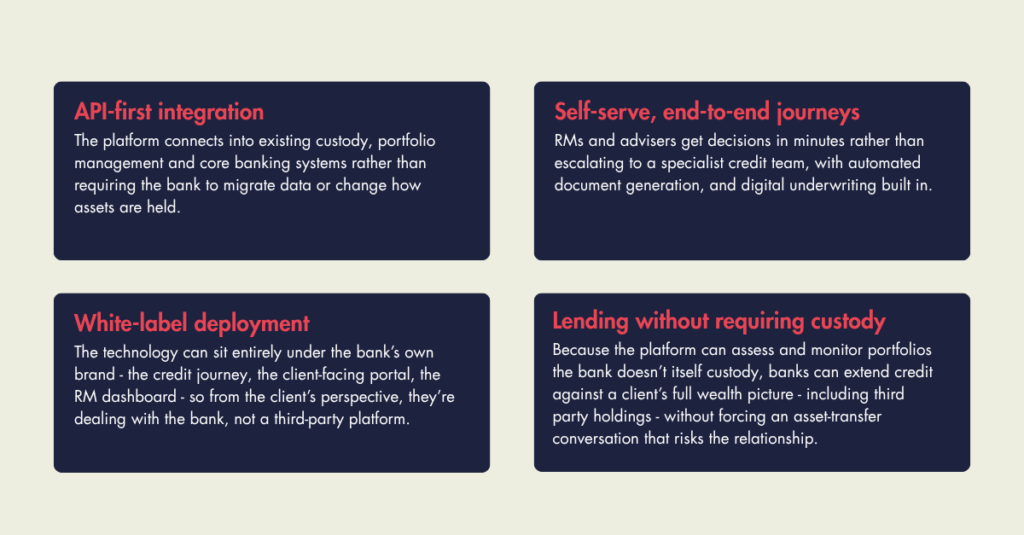
The effect is that a bank can offer a materially better, faster, more consistent Lombard lending experience without a multi-year core banking transformation programme. The technology becomes part of the bank’s existing infrastructure rather than a parallel system to maintain.
How the technology reduces risk-weighted assets and improves capital efficiency
For banks, the capital efficiency question is often the one that decides whether Lombard lending gets prioritised at all. Well-collateralised, investment-backed lending can be one of the most capital-efficient products on the balance sheet – but only if the infrastructure exists to prove it.
Embedded lending technology addresses this directly by automating:
- Collateral eligibility and haircut classification applied consistently and updated as regulatory frameworks change (including the recalibrated haircuts and look-through requirements coming with Basel 3.1 from January 2027).
- Real-time portfolio monitoring with automated margin calls and dynamic loan-to-value adjustments rather than periodic, manual review.
- Look-through calculation on fund holdings, so risk-weighted assets are calculated against a portfolio’s actual underlying exposures rather than defaulting to the punitive treatment applied when holdings data isn’t available.
- Embedded regulatory capital calculation, giving credit and finance teams a real-time view of RWA consumption rather than a quarterly reconstruction exercise.
The commercial consequence is significant.
Infrastructure that supports full look-through on fund-heavy collateral can bring average risk weightings down substantially compared with a fallback, no-look-through approach. This releases Tier 1 capital that would otherwise sit against risk the bank isn’t carrying, and improves RoE on the lending book.
Use cases: how banks are putting embedded lending technology to work
The shape this takes varies by bank, but a few patterns are consistent:
- Extending Lombard lending across the existing book – Banks with large custodied or advised books, but low Lombard penetration relative to the global average, use embedded infrastructure to make lending a self-serve option across the whole client base. This expands opportunities beyond the UHNW and deep down through the HNW echelons and into the Affluent segment.
- Lending against assets the bank doesn’t custody – Where clients hold investments elsewhere, banks use the platform to assess and monitor the collateral without requiring a custody transfer, opening up lending revenue on relationships that would otherwise sit outside the credit conversation entirely.
- White-labelled digital lending journeys for RMs and clients – Rather than building a proprietary platform, banks deploy the technology under their own brand to give relationship teams modern, self-serve credit journey – decisions in minutes instead of referral to a credit desk.
- Basel 3.1 readiness – With the PRA’s Basel 3.1 rules taking effect from January 2027, banks are using embedded infrastructure to get ahead of the capital treatment questions – mapping collateral books, fixing fund look-through data pipelines, and automating RWA calculation before it becomes a board-level gap.
What to look for in a fintech and banking infrastructure partner
Not every fintech vendor is built to sit inside a regulated bank’s infrastructure. Banks evaluating the best fintech companies for loans and lending infrastructure are typically weighing a fairly specific set of criteria:
| Depth of integration | Not just a standalone front-end – the technology should connect into existing core banking, custody and risk systems rather than requiring the bank to work around it. |
| True white-label capability | The bank retains the client relationship throughout the journey. |
| Regulatory capital treatment | Built into the product, including RWA and look-through calculation, rather than left to the bank to solve separately. |
| Real-time risk management | Including automated monitoring and margin calls, as a replacement for manual, spreadsheet-based processes. |
| Flexibility on custody | Lending isn’t artificially constrained to assets the bank already holds. |
This is the thesis Firenze has built its platform on. the core barrier between banks and the lending revenue sitting dormant in their client books was appropriate infrastructure.
Looking ahead
By 2030, embedded, investment-backed lending is likely to be a standard part of banking infrastructure rather than a specialist offering. Banks that move early are positioned to:
- Grow lending revenue and assets on the balance sheet without a proportional increase in operational risk.
- Improve capital efficiency and return on equity through better risk-weighted asset treatment.
- Deepen client relationships by offering liquidity without requiring clients to sell down or move assets.
- Differentiate through a materially faster, white-labelled digital experience.
If you’re a bank interested in talking to us about embedding Lombard lending technology into your existing infrastructure, get in touch with our team.