
Shrinking tax allowances are pushing more clients into offshore bonds. But without the right planning, the same wrapper designed to protect their wealth can unintentionally lock them out of it.
Recent tax reforms have redrawn the map for higher-rate investors. Both the Capital Gains Tax annual allowance and dividend allowances have dropped sharply, meaning the hunt for tax-efficient structures has become a permanent feature of every planning conversation.
Offshore bonds have become an increasing part of the solution for advisers working with clients on retirement planning and intergenerational wealth transfer but they are not yet commonplace.
To understand why that is changing, it helps to hear from someone who has spent a career working with them. Ken Chapman, wealth planning and offshore bond specialist, has watched the wrapper move from the margins to the mainstream.
“New investment into offshore bonds hit a record of £10.5 billion in the twelve months to June 2025, more than doubling from the previous year,” he told me. “The wrapper is having a moment but the conversation around it remains incomplete.”
The appeal, as Ken explains it, comes down to control. There is no tax inside the bond when investments are sold at a profit, meaning the portfolio manager can buy and sell freely without the tax implications that would follow in a standard account. This gross roll-up effect, compounding over time, can make a material difference to long-term outcomes.
Tax and estate planning with offshore bonds
Clients also retain choice over when to pay tax, since liability arises on surrender of the bond rather than on individual transactions within it. Segments can be assigned to beneficiaries without triggering a tax charge, making the bond a useful estate planning device.
For retirement planning in particular, the offshore bond can serve as a dependable long-term engine. Invest, defer tax on income and gains for a number of years, then draw down using the 5% annual capital withdrawal allowance in retirement.
Ken is clear on a common misconception here: “That allowance is often misunderstood as income. It is actually a return of the investor’s own capital, taken without immediate tax liability, a distinction that matters enormously when structuring a client’s retirement income.”
And yet there is a structural constraint that does not get enough airtime. Ken is emphatic on this point.
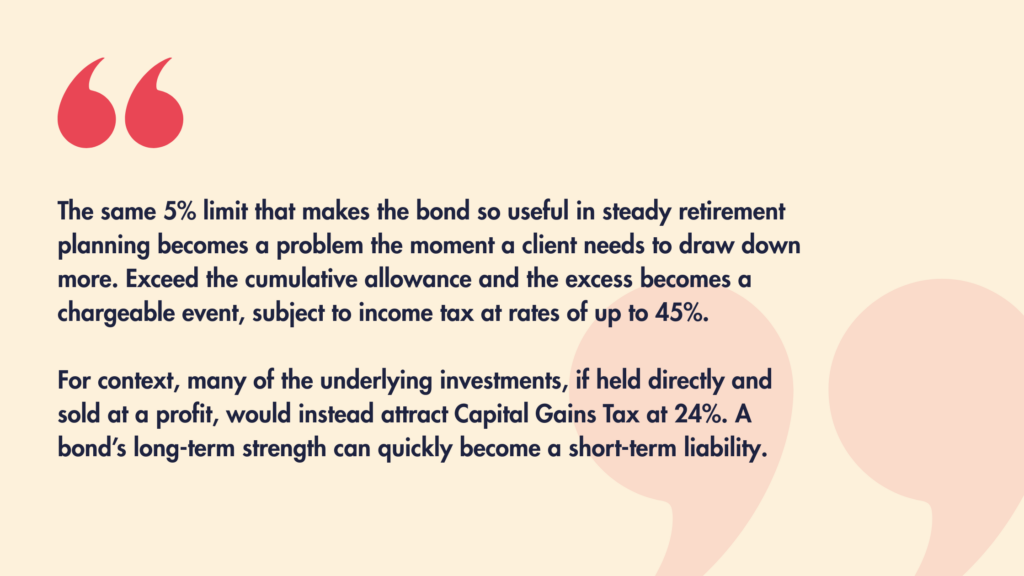
This is where many advisers stop the conversation. They should not. Lombard lending, where clients borrow against the value of their portfolio rather than drawing from it, resolves that tension directly.
How Lombard lending can unlock liquidity for clients with an offshore bond portfolio
Until recently, this kind of arrangement was largely the preserve of ultra-high-net-worth clients, the sort of facility buried in the private banking offering of a large institution, available only to those with significant assets and the right relationships. That is changing.
At Firenze, we have built a platform that makes Lombard lending available at lower asset thresholds, designed specifically for the adviser market – meaning a solution that once required a private banking relationship can now be part of a standard planning conversation.
The timing matters. As more clients move into offshore bonds in response to the shifting tax environment, liquidity constraints are becoming a more common problem. For once, a solution has arrived before the problem has fully taken hold.
Consider the kind of situation that comes up more often than advisers might expect. A client holds a substantial offshore bond, structured carefully over a number of years as part of their retirement and estate planning. In Ken’s experience, “clients are often caught off-guard when they need liquidity and realise how constrained their options are.”
They want to purchase a second property or downsize but do not want to be caught up in a property chain. With a Lombard facility in place, they can borrow against the bond to fund the purchase. They will then repay the loan when their original property sells, leaving the wrapper untouched and their tax position unchanged throughout.
Similarly, where an inheritance tax liability falls due on death, a Lombard facility can provide the liquidity to meet that obligation without requiring the bond to be surrendered and a tax charge triggered on the gain.
Offshore bonds are not a simple product and they are not right for every client. The fee structure, the investment restrictions, the income tax treatment on gains all require careful thought and good advice.
But for the right client, pairing an offshore bond with a Lombard lending facility can allow clients to retain the tax flexibility of an offshore bond without compromising on the liquidity.
If you have a client who could benefit from access to a Lombard facility or if you just want to find out more, speak to our team here.