
Lombard lending is one of the most capital-efficient products a bank can run. It is also one of the easiest to evidence badly.
Purpose-built technology turns a process built on spreadsheets and judgement into one that your regulators, auditors and board can trace line by line.
It’s important to understand the true impact of Lombard lending technology on bank operations, including:
- Where the compliance burden in Lombard lending sits
- How technology tightens risk-weighted assets (RWA), reporting and liquidity risk control
- What risk and compliance teams should ask of Lombard lending software
Financial compliance in investment-backed lending rarely fails because the product is risky. Loans secured on liquid, daily-valued portfolios are amongst the safest on the book.
It fails on evidence. Can you show, for any loan on any date, which collateral was eligible, which hair-cut applied, and why the RWAs came out as they did?
With Basel 3.1 applying in the UK from 1st January 2027, that question is about to be asked more often, and in more detail. 2027 brings added opportunity for further reduction of RWA via funds look-through, but also additional workload for risk and compliance teams.
Why Lombard lending compliance can be fiddly
The regulatory burden can be broken down into four, linked problems:
- Collateral is assessed position by position – every instrument needs classification, hair-cut application, and another check when ratings, rules or market conditions change.
- Funds need look-through – collective instrument undertakings dominate client portfolios, and without verified holdings data the capital treatment falls back to more punitive options.
- Monitoring runs on spreadsheets and email – valuations, LTVs, and margin calls often depend on individuals, which creates key-person risk and weak audit evidence.
- The numbers live in several places – the investments, credit, and risk teams can each hold their own view of collateral and exposure, and reconciling them eats time before every regulatory return and ICAAP.
None of this is difficult in isolation. But, at scale, it becomes an operational risk and problems frequently surface when changes in regulation or approach cause dislocations in the data-trend.
RWA: from estimate to calculation you can defend
Well-collateralised Lombard exposure can attract very low-risk weights under the CRR financial collateral methods, which is why capital is the headline benefit. But the benefit is only as good as the inputs behind it.
Purpose-built technology applies your chosen method to every loan consistently and automatically. Collateral is revalued daily, which matters because standard hair-cuts assume it and should be scaled up where revaluation is less frequent.
Fund look-through runs on verified holdings data. And when a rule changes, as several do under Basel 3.1, the change is made once in configuration and flows through every loan, rather than through thousands of manual reassessments.
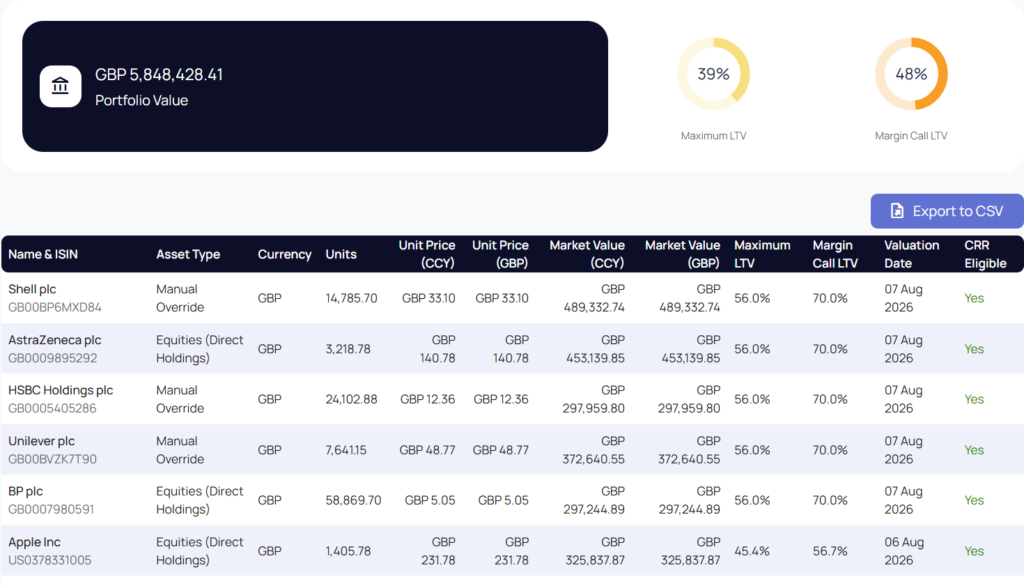
The result is RWA that reconciles loan by loan to the underlying collateral. When a reviewer asks why a position carries 0% or 20%, the answer is a click away rather than a spreadsheet hunt.
We covered the specific rule changes in a previous blog on how to prepare your Lombard lending infrastructure for Basel 3.1.
More rigorous numbers, fewer reconciliations
Good bank compliance software gives finance and risk management a single source of truth. The same exposure, collateral value and RWA figure feed credit decisions, capital reporting and board packs.
In practice, that means:
- Reporting inputs generated from the system of record – not rebuilt each quarter, so regulatory returns and ICAAP evidence become an extra rather than an exercise
- A complete audit trail – every eligibility decision, hair-cut, over-ride and margin call is time-stamped, attributed and linked to the policy version in force
- Point-in-time reproducibility – so any historical position can be restated as it stood on a given date
- Fewer manual touchpoints – reducing both error and key-person dependency
Liquidity risk and advanced risk assessment, in real-time
Collateral is only as good as how quickly it can be sold. Technology gives risk teams a live view of the collateral pool by liquidity profile, separating listed securities from funds, alongside concentration by issuer, sector and currency. Treasury sees the same data, including undrawn facilities that feed liquidity risk management and the ILAAP.
Real-time monitoring also changes how margin calls work. Loan-to-value ratios update continuously, and calls are triggered within contractual windows rather than whenever someone next checks the spreadsheet.
That makes advanced risk-assessment techniques in the banking industry – such as portfolio-level stress testing, correlation-aware LTVs and early warning flags – routine rather than special projects. Where AI is used to surface emerging risks, human assurance gates keep every decision renewable, in line with the PRA’s model risk management expectations.
What risk and compliance teams should ask of Lombard lending software
| Can it show the method, hair-cut and data behind any RWA, for any date? | Evidence for internal audit and banking regulators |
| Are hair-cuts and eligibility rules configurable and version-controlled? | Regulatory change becomes configuration, not a rebuild |
| Is fund holdings data sourced independently, with gaps flagged? | Protects look-through treatment |
| Is the audit trail complete and exportable? | Reporting and ICAAP evidence on demand |
| Does it integrate with core, custody and reporting systems? | One set of numbers, no re-keying |
| Is AI governed, with human sign-off? | Model risk management |
Looking ahead
The opportunities and requirements of Basel 3.1 will exacerbate the gap between those banks with good technology and those without. Banks that put the right infrastructure in place now gain a Lombard book their risk and compliance teams can defend, and a lighter burden every reporting cycle after that.
That is the problem Firenze’s platform is built to solve: real-time RWA analysis, automated collateral eligibility and hair-cut classification, funds look-through and continuous monitoring, in one auditable system.
If you work in risk or compliance at a bank and would like to see how this would look in your environment, get in touch with our team.